

What Does an Accessible Walk-In Shower Really Cost? UK Prices & What You Get for Your Money
Perhaps you’ve started holding onto the side of the bath when you step in. Maybe getting your leg over the edge is becoming harder, or you’ve had a slip that has knocked your confidence. Or perhaps you’re reading this because you’re worried about your Mum, Dad or another relative.
You know the bathroom needs to change, and replacing the bath with a walk-in shower seems like the obvious solution. But who do you turn to, who can you trust and what is it going to cost?
Current website research suggests a walk-in shower can be installed from around £2,000 to more than £10,000
So why are there so many different prices and what will a walk-in shower actually cost?
The answer depends largely on what is defined as a walk-in shower, and, most crucially, what is included in the price. A relatively straightforward shower installation and a complete accessible bath-to-shower conversion are not the same job.
For somebody who simply wants a new shower, a basic installation may be perfectly adequate. But if you are adapting your bathroom because stepping over the bath has become difficult, your balance has changed, you use a walking aid, or you want the bathroom to remain suitable as your needs change, there can be considerably more involved.
At Living Well Bathrooms, our accessible walk-in shower packages currently start from approximately £5,495 excluding VAT, with different levels of adaptation depending on your needs, bathroom and budget.
This guide explains why prices vary, what you should expect an accessible installation to include and, most importantly, how to compare quotations properly before deciding who to trust with your home.
How much does an accessible walk-in shower cost in the UK?
There isn’t one meaningful UK price for a walk-in shower because the term describes everything from a standard shower tray and screen to a fully adapted bathroom designed around someone’s mobility.
For comparison, published UK price guides currently show considerably different figures. Checkatrade suggests around £2,100–£2,500 for many walk-in shower installations, while MyBuilder gives a much broader range of approximately £1,500–£15,000, depending on the specification and complexity. Those figures aren’t necessarily contradictory and they can simply be describing different jobs.
For an accessible bathroom, the work could involve removing and disposing of your existing bath, changing drainage and pipework, preparing or repairing the floor, installing a new pump, installing a low-level or level-access shower area, wall panels, safety flooring, a shower seat, grab rails, electrical work and making good walls and ceilings.
That is why it’s important to compare what scope of works companies offer, as well as price.
Living Well Bathrooms walk-in shower prices
We offer three different levels of accessible shower installation so that our customers aren’t forced into paying for features they don’t need. We believe in retaining and reusing features where possible to keep costs down, alternatively we can replace the entire bathroom.
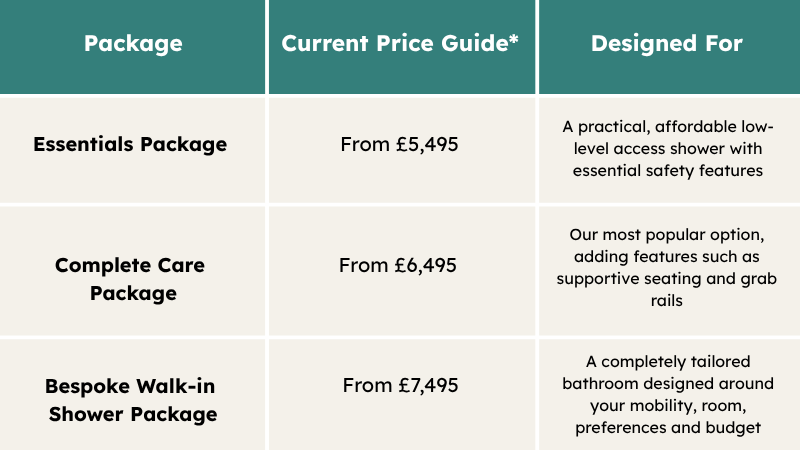
Current Living Well Bathrooms guide prices exclude VAT and are subject to a home survey and individual requirements. Your free written quotation will reflect your home and chosen specification. Current prices are confirmed on the LWB walk-in shower page.
Current offer: Save £600 off a new bathroom – subject to terms and conditions.
Ready to make your bathroom safer? Call our team today on 0800 731 6495 to book your free home survey.
Here you can compare our Essential Care, Complete Care and Bespoke walk-in shower packages. Take a moment to read through and see if either of these are what you’re looking for. Remember – these are guides and we can always add or remove features.
Before Comparing Prices, Check What You’re Actually Comparing
Finding a lower price online can feel reassuring, particularly when you’re trying to make an essential bathroom adaptation affordable. But before comparing two figures, check that they describe the same amount of work. A price for a shower tray, screen and fitting isn’t directly comparable with a quotation for removing a bath and delivering a finished accessible bathroom.
A cheap price you’ve seen online may only refer to:
- the shower itself
- supply only
- a tray and screen
- fitting a shower into an existing shower area
- labour only
It’s important to check exactly what’s included. For example, Checkatrade’s current guide lists bath removal separately at around £300–£500 and explains that flooring, structural alterations, electrical upgrades and more extensive finishing work may not be included in some quotations.
So if you see a very low advertised price, don’t automatically assume you’ve found a great deal, you may end up paying even more in the long run. Instead ask:
“What exactly is included from the moment you arrive until my new shower is completely finished and ready for me to use?”
That question makes quotations far easier to compare.
What’s Involved in Turning a Bathroom Into a Safer Showering Space?
A walk-in shower designed around reduced mobility is about considerably more than swapping one bathroom product for another. It will be dependent on your needs (a bathroom can look accessible in a photograph but still be awkward for the person actually using it) daily routine, current features and what products are required.
Accessible design should start with the person, not the product.
A comprehensive installation should involve the following, so when obtaining quotes you should ask these questions:
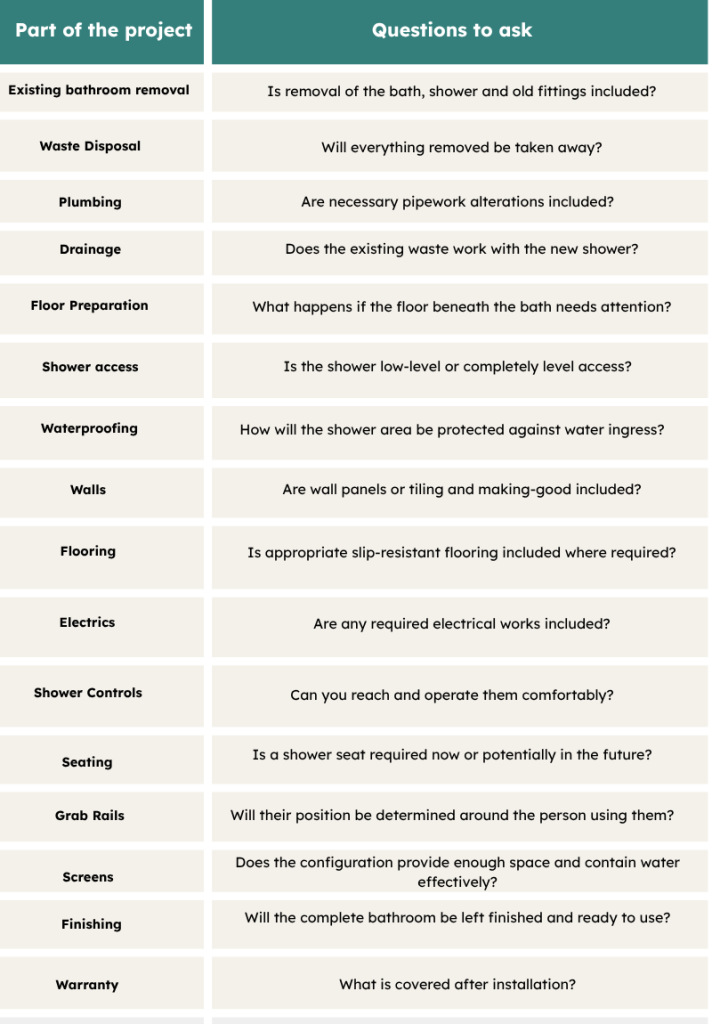
That last point matters a great deal. A reputable bathroom company will offer warranty and aftercare, giving you peace of mind any problems can be resolved.
What affects the cost of a walk-in shower?
1.Removing your existing bath
Taking out a bath can reveal pipework, flooring or walls that need attention before the new shower can be fitted, sometimes it is possible to investigate what’s behind the bath panel and flooring prior to removal but sometimes that’s not possible and only discoverable once removed.
2. Low-level VS level-access
If you can comfortably manage a very shallow step, no higher than 40mm, a low-level shower tray may provide the access you need while keeping the project more straightforward.
If you use a wheelchair, walking frame or need completely step-free access, a level-access shower may be more appropriate and that can require additional floor and drainage work.
3. Your existing plumbing and drainage
Keeping the pipework in broadly the same location can sometimes help control costs. Moving or replacing old drainage systems, pipework or electrical supplies can increase the cost.
4. Seating and support
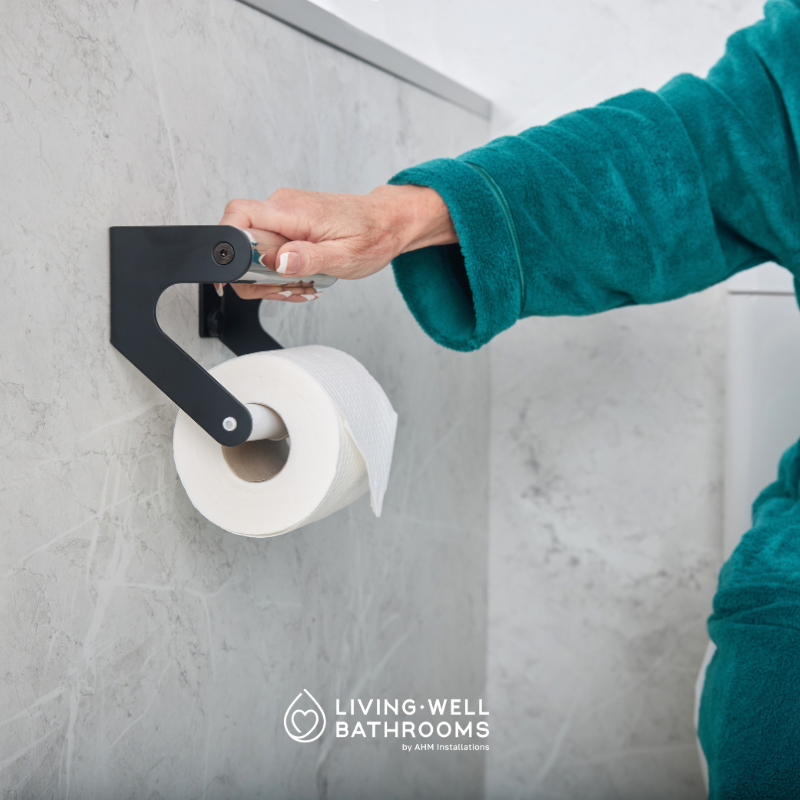
A fixed or drop-down seat, correctly positioned grab rails and easy-to-operate controls can make an enormous difference to safe showering.
But they need to be positioned around you, not simply installed where they happen to fit. A well positioned seat allows for the user to turn the shower on comfortably whilst seated, without having to twist, or reach. Grab rails should also be positioned where your body naturally reaches for support.
5. The size and condition of your bathroom
Every house is different and the floor type, room dimensions, existing fittings and the condition of the bathroom can all affect the work involved. A house with a bathroom 20-30 years old is likely to warrant a full refit and replacement of plumbing, drainage and water systems. Whereas a contemporary home may require less.
6. How much of the bathroom you want to change
Some people simply need to remove a bath and make showering safer and have no desire to change the remaining basin, toilet, tiles flooring, mirror, radiator etc. Others may decide that if the room is being adapted, they would also like to change the toilet, basin, flooring, tiles, storage or overall design.
Neither choice is wrong, and ultimately it will be decided based on what you need, what you would like and what your budget allows.
Walk-in shower or wet room – which might you need?
A walk-in shower isn’t necessarily the right answer for everyone. If you need greater manoeuvring space, use a wheelchair, or another person helps you bathe, a wet room may provide more usable space and flexibility.
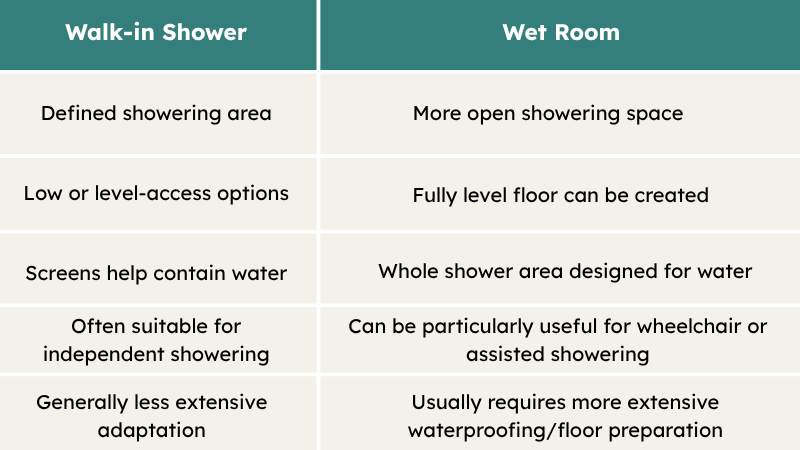
Not sure which you need? Read our Walk-In Shower vs Wet Room guide
Could you pay 0% VAT on an accessible walk-in shower?
Possibly, if you qualify. HMRC allows certain bathroom adaptation work to be zero-rated for VAT when it is necessary because the person is chronically sick has a registered medical condition, or is disabled.
You don’t need to be in receipt of a particular disability benefit to qualify either, although eligibility conditions still apply. That can effectively remove the standard 20% VAT from qualifying work.
For example – if qualifying work would ordinarily cost £7,200 including 20% VAT the equivalent zero-rated price would be £6,00. That’s a potential saving of £1,200.
Read our VAT exemption guidance here if you want to know more.
Why we don’t think an accessible shower should be quoted from a photograph
You can buy almost anything online today and an accessible bathroom is no different – trust us when we say it will almost always cost you more in the long run. We’ve been called to many a frustrated customer who fell into the trap of doing this and we’ve always ended up having to replace entire bathrooms at more cost for the customer.
The company who designs your bathroom needs to understand not only the dimensions of the room, but how you actually use it, this can affect the layout, placement of products and type of features and fixings are recommended.
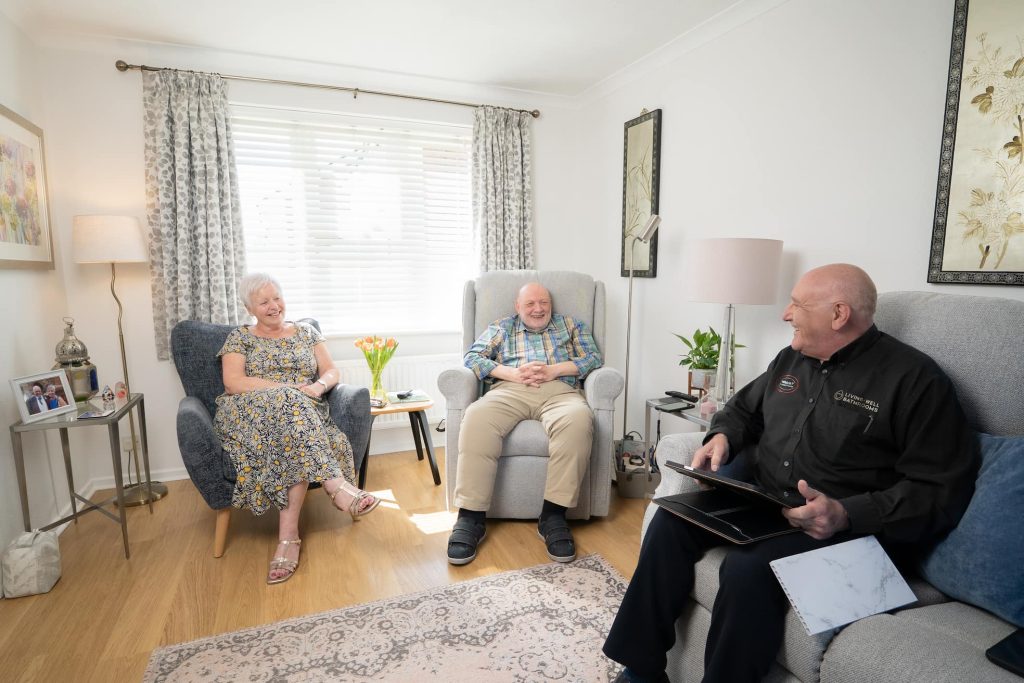
That’s why at Living Well Bathrooms we offer a free, no-obligation home survey. This enables us to have a look at the current layout, understand your needs and from there we provide a no obligation design and quotation pack with images so you can visualise your new bathroom.
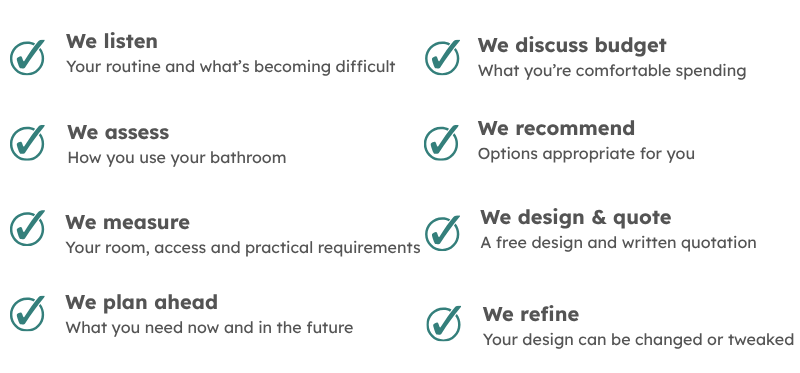
What happens during a free home survey?
The home survey isn’t intended to tell you what you must buy, the surveyor will spend time getting to know you, your routine, what’s becoming difficult and what you want from your bathroom to make showering and personal hygiene tasks easier.
They’ll also consider the practical side of the room: measurements, access, existing fittings, plumbing, drainage and other factors that may affect the design.
The surveyor who comes to see you will remain a point of contact while the design and quotation are developed, so if the first proposal isn’t quite right, it isn’t set in stone and can be amended.
We can change it.
Keeping costs manageable matters to many of our customers, so tell us your budget. We can look at where money genuinely needs to be spent for safety and usability and where features may be unnecessary. There is no benefit in selling someone bathroom features they don’t need.
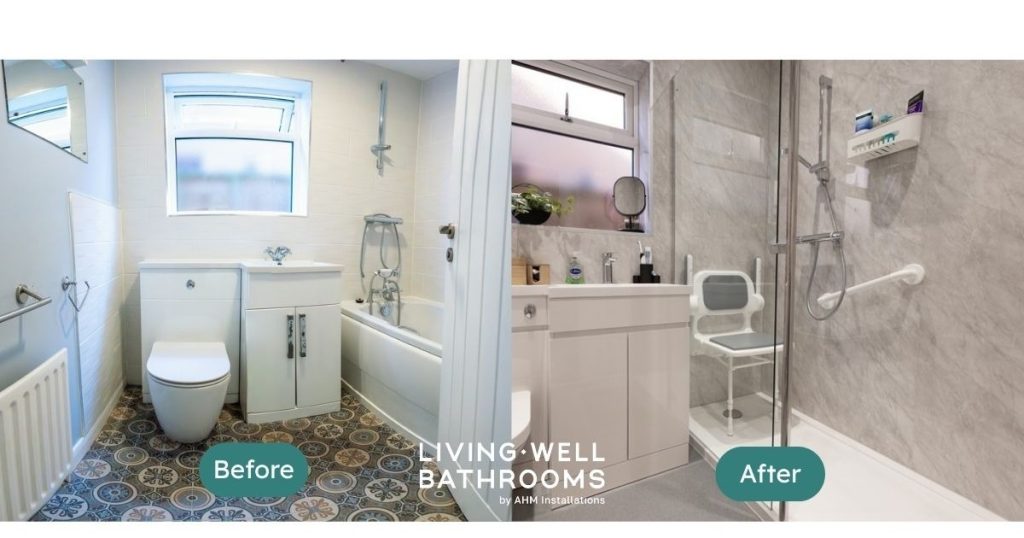
Real Life Case Study – Transforming Mrs G’s hard to use bath into a safer shower
Customer: Mrs G, Lincoln.
The problem: Using the bath had become more difficult and even more so after a hip replacement.
What mattered to her: Being able to shower/bathe without the fear that one day she may trip trying to get in or out of the bath.
The solution: A low-level access shower fitted in the same footprint as the old bath, with a slip resistant shower tray, fixed shower seat, grab rails and easy clean wall panelling for low maintenance.
The result: A risk and worry free start to each day.
Mrs G told us: “I didn’t want to spend silly money. I’d been quoted lots more by other companies but Living Well Bathrooms designed me a bathroom that I wanted and needed and it hasn’t broken the bank. I love my new shower, and look forward to using it each day now I don’t have to worry”.
Approximate project price: £7500
VAT relief: 20% VAT exemption applied.
How to compare walk-in shower quotations properly
We always recommend customers to obtain at least three quotes and once you have those, it’s important to compare, but don’t simply put three totals next to each other. Create a simple comparison sheet like this so you can see exactly what you’re getting for your money.
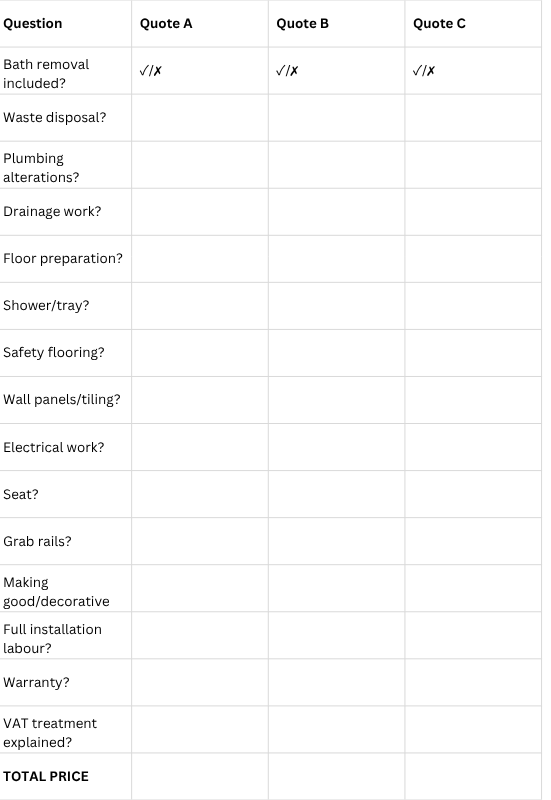
A £4,000 quotation and a £7,000 quotation aren’t necessarily £3,000 apart if one leaves several thousand pounds’ worth of work for you to organise separately.
Choosing someone to install an accessible shower
Price matters and so does knowing who you are inviting into your home and who will be responsible if something goes wrong.
Before choosing an installer, we’d recommend checking several things to check first:
Look for independent endorsement
Look for recognised schemes such as Which? Trusted Traders, where businesses go through an assessment process rather than simply displaying customer testimonials on their own website. A Which? Endorsed company is constantly monitored to ensure it protects the customer at all times.
Read independent customer reviews

Don’t rely solely on testimonials selected by the company displayed on a website – anyone can write those. Instead, look at independent platforms such as Trustpilot and read the actual comments, including recent reviews and how the business responds when a customer has a problem. Trustpilot profiles also tell you if a company asks for reviews or not, it’s always a good sign when customers leave reviews through their own choice.
You can also read how the company responds when a customer leaves a negative review.
Check how long the company has been trading
There is a difference between “Our company has been installing accessible bathrooms for 27 years” and “Our team has 27 years’ combined experience.”
Both may describe experience, but they tell you different things. Living Well Bathrooms was established in 1999, originally as AHM Installations (Assisted Health & Mobility). That means our business has spent more than a quarter of a century helping people adapt their homes.
Ask who is responsible for the whole job
Will the company manage the complete installation, or will you need to organise plumbers, electricians, flooring or finishing separately? Having to coordinate additional tradespeople can be time consuming and a company will take care of everything so you don’t have to worry.
Ask what happens afterwards
Check warranties, aftercare and who you contact if you have a problem once the installers have left. Check if the products are covered and /or the installation itself. Also ask if lifetime or extended warranties are included or if they are an additional cost.
So, how much should you budget?
For a straightforward non-specialist walk-in shower, you’ll find lower prices advertised online. For a complete accessible bath-to-shower conversion, you should expect the cost to reflect the amount of work required, not simply the price of the shower tray and screen.
At Living Well Bathrooms, our current guide prices start at:
Essential Care — from £5,495*
Complete Care — from £6,495*
Bespoke — from £7,495*
*Prices exclude VAT and final pricing depends on your home and requirements. Eligible customers may qualify for VAT relief.
But the most useful question isn’t “What’s your cheapest walk-in shower?” it’s “What do I need to make showering safe and comfortable again — and what’s the most sensible way to achieve that within my budget?”
That’s the conversation we’d rather have with you.
Frequently asked questions about walk-in shower costs
How much does it cost to replace a bath with a walk-in shower?
Prices vary considerably according to the scope of work. General UK cost guides may quote around £2,500 for relatively straightforward bath-to-shower conversions, whereas a complete accessible installation involving additional floor, drainage, safety and finishing work can cost considerably more. Always compare what’s included rather than the headline figure alone.
Can I get a walk-in shower VAT-free?
Qualifying bathroom adaptations can be zero-rated for VAT when HMRC’s eligibility requirements are met. This can include replacing a bath with a shower where the work is necessary because of a chronic illness or disability.
Is a level-access shower more expensive?
It can be. Creating completely level access may require additional floor preparation, drainage or structural work compared with installing a low-level tray. Your bathroom needs to be assessed to establish what’s possible.
What’s the difference between a walk-in shower and a wet room?
A walk-in shower normally has a defined showering area with a low-level, slip-resistant tray, while a wet room involves creating a level access showering space with more extensive waterproofing. Wet rooms can be particularly useful where wheelchair access or assistance from another person is required.
Are walk-in showers suitable for older people?
They can be. Removing the need to step over a high bath side can make showering easier for people experiencing reduced balance, strength or mobility. The appropriate design depends on the individual rather than age alone.
What is included in a Living Well Bathrooms quotation?
Your fixed price quotation is prepared following a free home survey and is based on the layout, pre installation work involved (removal of old fixtures and amending pipework, the products and installation cost itself. There are no hidden costs. You will receive the quotation fully written and with designs to help you visualise your new bathroom.
Can you work to a budget?
Yes, we much prefer to do this. If we know from the start we can design a bathroom you can afford. The aim is to identify the features that matter for your safety and independence and build an appropriate solution around your requirements and available budget.
Start with a free home survey
If this article has been helpful because you are finding it harder to use your bathroom and would like to make changes, get in touch. You don’t need to know exactly which shower, tray, seat or package you need, we’ll go through all the options when we visit you at home.
Just start by telling us what isn’t working anymore.
We’ll look at your bathroom, listen to what you need and help you understand the options available. including the costs.
Call us today on 0800 731 6495 to book a free home survey, or you can click the buttons below.
Explore our Walk-In Shower packages →